


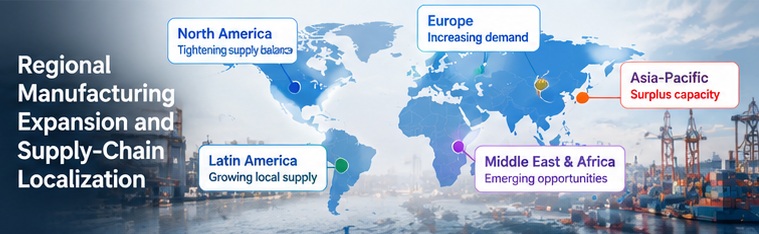
The global market for precipitated silica is growing more regional as manufacturers expand new capacity close to key tire, rubber and specialty material markets, while building access to local raw materials and supply chains.
India is growing as an important regional investment market: AksharChem has expanded its Dahej precipitated silica capacity to 18,000 tonnes per year by 2025, while Tata Chemicals is planning to add 50,000 tonnes per year of specialty silica capacity at Cuddalore. India is also building out an alternate silica manufacturing base around rice husk ash with participation from Brisil Technologies, Blue Ocean Biotech and others.
Chinese manufacturers continue to drive production growth: Zhuzhou Xinglong, Zhejiang Xinna, Quechen Silicon Chemical, Jinsanjiang and others represent a large pool of capacity with integration advantages around sodium silicate and other raw materials.
Southeast Asia is also seeing increased investment: Quechen has approximately 45,000 tonnes per year of precipitated silica capacity in Thailand with another 25,000-tonne per year under construction. Jinsanjiang has announced plans to establish a new silica manufacturing facility in Malaysia with investment up to RMB 600 million, though capacity targets have not been disclosed.
In Mexico, Silkimya has commissioned a 12,000-tonne-per-year facility at Altamira in 2024 and is planning to expand the site to approximately 25,000-30,000 tonnes per year to better serve regional demand for domestically produced silica.
North America is taking a different approach: while Evonik is expanding Charleston and closing precipitated silica production at Havre de Grace, Qemetica's acquisition of PPG's silica business has reshaped ownership of significant regional manufacturing assets.
And Europe is emerging as a center for lower-carbon and alternative silica technologies: Solvay's bio-circular silica production at Livorno and the LIFE-SYNFLUOR demonstration project in Sardinia represent important innovations in this area. The result is a growing regionalization of competition among the largest precipitated silica producers. China provides scale and integration advantages, India combines scale with alternate production technologies around rice husks, Southeast Asia offers both manufacturing capacity and renewable feedstocks, Mexico is focusing on localized supply, North America is consolidating around key manufacturing hubs, and Europe is pioneering lower-carbon technologies and innovations.