


The global precipitated silica market is witnessing a significant transformation with companies introducing rice husk ash, waste minerals, and circular products into production.
First, in January 2026, Solvay started up a bio-circular highly dispersible silica (HDS) production line at its Livorno, Italy, site that uses bio-based sodium silicate made from rice husk ash: the company estimates production emissions of this product are some 35% lower per tonne than its standard HDS process.
Solvay is also accelerating the development of its circular production concept in Asia: Starting in 2026, the company’s Qingdao, China, and Gunsan, South Korea, sites are slated to incorporate ISCC PLUS-certified waste sand into their raw materials, enabling more than 50% of the firm’s HDS capacity in the region to use circular feedstocks.
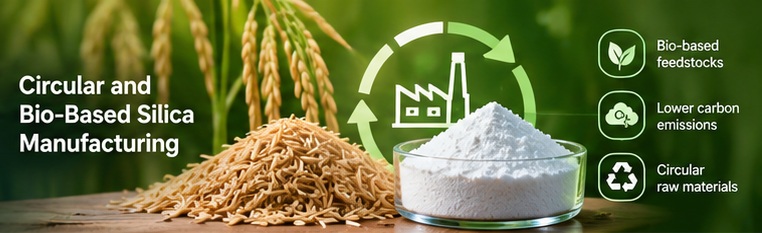
Evonik is taking a similar approach, leveraging its cooperation with Pörner Group and Phichit Bio Power to produce sodium silicate from rice husk ash in Thailand for ULTRASIL® precipitated silica. This effort is targeted to reduce the carbon footprint of the silica by roughly 30% and has already enabled commercial production of ULTRASIL eCO at the company’s Egesil Kimya site in Turkey in June 2026 after ISCC PLUS certification was obtained.
In addition, emerging producers such as Brisil Technologies in India and Blue Ocean Biotech are growing their capacities: The former is targeting 36,000–60,000 tonnes/year of silica from rice husk ash by 2025 after building a 4,800-tonne/year pilot line, and the latter is targeting some 10,000 tonnes/year of RHA-based silica at its current facility with additional capacity.
These trends suggest that future precipitated silica production capacity will encompass both conventional and circular processes in the industry. As a result, for the major producers of precipitated silica, the competition for market share is intensifying, with product quality, production scale, and sustainability performance - particularly carbon footprint, renewable content, and circularity - becoming more critical differentiators in the market.