


The world market for precipitated silica is seeing a shift in supply-demand dynamics, as manufacturers continue to expand their capacities even as global production outstrips demand. Nevertheless, the gap between supply and demand is set to narrow significantly by 2031.
As per ChemInsider Market Intelligence’s assessment, global demand for the product in 2026 stands at 87% of total capacity. By 2031, the global precipitated silica capacity is set to rise to 4.06 million tonnes, whereas demand will amount to 3.95 million tonnes. As a result, the nominal excess of supply over demand will drop to 109 thousand tonnes, with demand accounting for 97.3% of capacity. In other words, demand growth is forecast to outstrip the increase in supply, growing by 4.4% per year on average in the 2026-2031 period, versus 2.1% for capacity.
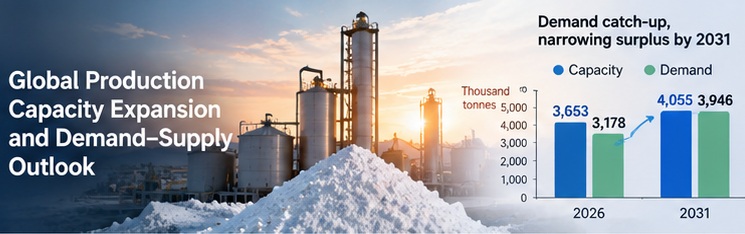
Even as the overall surplus in the world market for precipitated silica rises, some manufacturers continue to invest in new capacity, which is targeted to meet regional demand, introduce new products, and improve operating efficiencies.
In India, AksharChem raised its Dahej capacity to 18,000 tonnes per year in 2025, and Tata Chemicals is set to add 50,000 tonnes per year of capacity for producing specialty silica at Cuddalore by Q4 FY2028.
In North America, Evonik is expanded its Charleston facility by approximately 50%, while it continues to consolidate its position by exiting the precipitated silica business at Havre de Grace. Mexico’s Silkimya commissioned a new 12,000 tonnes per year capacity at Altamira in 2024 and is considering an expansion to about 25,000-30,000 tonnes per year.
The trend suggests that manufacturers of precipitated silica continue to favor investments to meet regional demand, develop products with higher value, and enhance operating efficiencies, rather than expanding the overall installed capacity. As a result, for the major precipitated silica producers, the challenge ahead will be to balance the need for new investments with the prospect of a significantly tighter global supply-demand gap.