


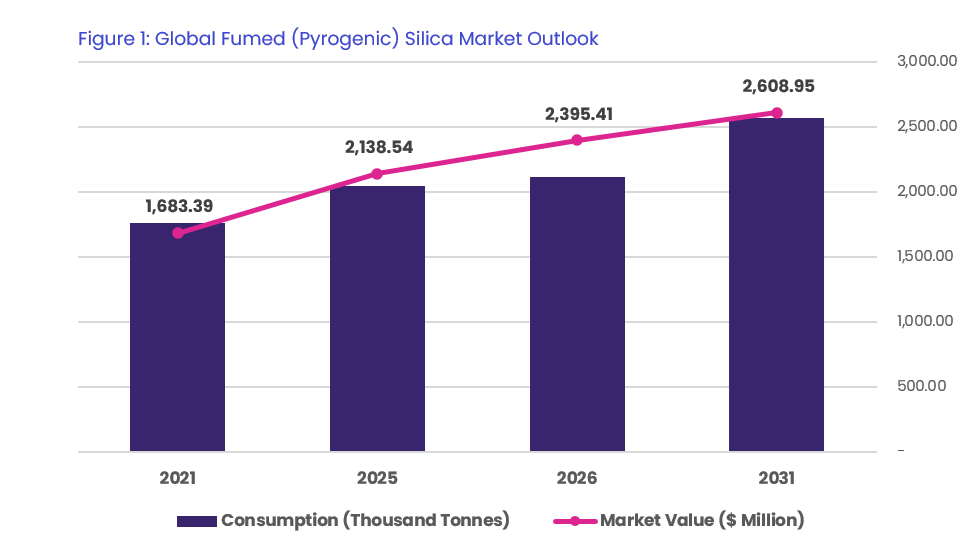
The global Fumed (Pyrogenic) Silica market is set to grow steadily to 2031, driven by growth across several applications including silicone elastomers, electronic materials, adhesives & sealants, and high-performance coatings. In 2025, the Global Fumed Silica market was valued at around US$2.14 billion. The Global Fumed Silica market to reach US$2.40 billion, before reaching 513.7 thousand tonnes and US$2.61 billion by 2031. This represents growth in consumption at a compound annual growth rate (CAGR) of 4% between 2026-2031. However, this is not mirrored by revenue growth which is set to be much slower (1.7%) during the same timeframe.
The largest application for fumed silica continues to come from silicone elastomers. This was responsible for around 39.7% of global consumption in 2025. Fumed silica is now commonly used throughout silicone products to improve reinforcement, mechanical properties and performance. Demand from the automotive, industrial products, electrical, and specialist silicone markets will ensure that this remains the largest application in the market.
The Electronic Materials market is becoming one of the most important growth areas within the market. It is predicted to see the highest growth in consumption with consumption growing at a CAGR of 5.1% between 2026-2031. Increasing demands for high purity silica in semiconductor related applications such as chemical mechanical planarization. The Adhesives & Sealants market is also predicted to be a high growth market.
Asia Pacific remains the largest region in the market, contributing 53.6% of global consumption in 2025. Consumption is predicted to grow within Asia Pacific between 2026-2031 with demand growing to 296 thousand tonnes. China continues to be the largest market for demand however India is predicted to see some of the highest growth due to increased industrial applications.
The industry is also seeing changes in supply and demand. Global fumed silica production capacity is estimated to be 524,600 tonnes per annum in 2026. This means that there is enough nominal capacity for demand. However, factors such as grade, location, and plant utilization need to be considered. As a result, the market is set to see increased consumption but more focus on manufacturing efficiency, differentiation and high-performance applications.