



Global Precipitated Silica Market
Precipitated silica refers to a synthetic amorphous form of silicon dioxide obtained by precipitating soluble silicates under controlled conditions. It is commonly used as a reinforcing agent, functional filler, carrier, absorbent, and performance enhancing additive in tires, industrial rubber, chemicals & plastics, personal care & cosmetics, agriculture & animal feed, food, and paints, coatings & inks. Precipitated silica, especially in the form of highly dispersible grade, is used in tire manufacturing as a rubber additive to improve rolling resistance, wet grip, and overall performance. The global precipitated silica market is estimated to reach US$5.14 billion in 2026, and is projected to expand to around 4 million tonnes and US$6.27 billion by 2031, registering CAGR of 4% in value.
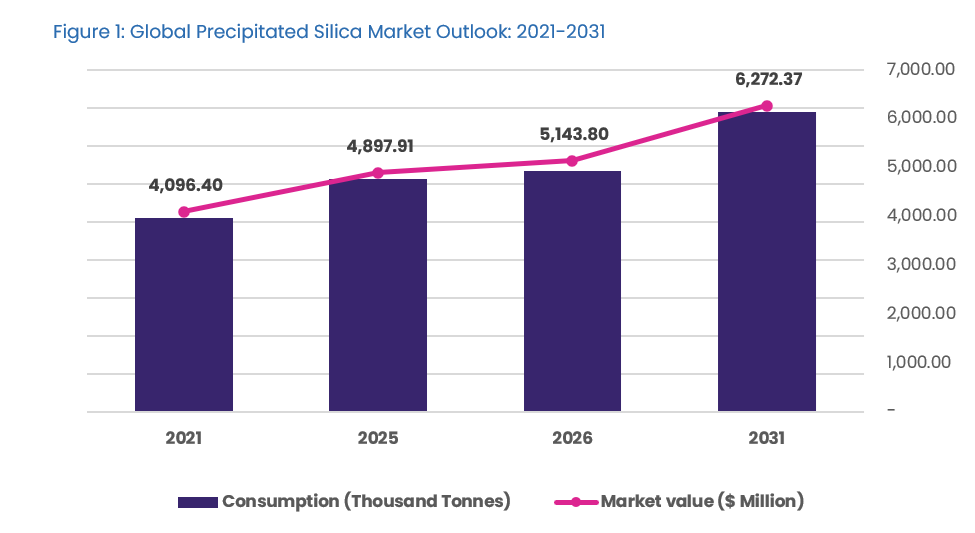
Tire manufacturing is expected to remain the principal growth driver, supported by increased use of highly dispersible precipitated silica in fuel efficient and high-performance tire compounds. Consumption related to tire manufacturing is projected to grow at a 6.3% CAGR through 2031, substantially exceeding overall market growth. Continued demand from industrial rubber, chemicals & plastics, personal care & cosmetics, agriculture & animal feed, and paints, coatings & inks is expected to create additional market opportunities.
The global precipitated silica market is projected to reach $6.27 billion by 2031, driven by increasing adoption of silica-reinforced tires and sustained demand across industrial applications. While Asia-Pacific continues to dominate global consumption and production, demand growth is expected to outpace capacity expansion, pushing the global demand-capacity ratio to 97.3% by 2031 and signaling an increasingly tight supply-demand environment.

Report Coverage
Global Precipitated Silica Market (2026 Edition) report provides in-depth analysis of the market size, consumption, value, production capacity, competition, and supply-demand dynamics of the global market. The study covers the historical period of 2021-2025, with 2025 being the base year, 2026 as the estimated year, and 2031 as the forecast end year. The market size and forecasts are presented in terms of consumption volume (thousand tonnes) and market value (US$ million), supported by an analysis of trends, growth drivers, opportunities, and restraints.
The report covers the following major areas:
- The market research report offers extensive analysis and evaluation across North America, Europe, Asia-Pacific, Latin America, and Rest of World. The study covers the country-level market size, consumption, and value for the United States, Canada, Germany, France, Italy, Spain, United Kingdom, China, India, Japan, South Korea, Brazil, Mexico, Russia, and Turkey. The report provides an analysis by each major country of the consumption volume, market value, application-level consumption, trend, and forecast through 2031.
- The report provides extensive analysis by application, including Tires, Rubber, Chemicals & Plastics, Agriculture & Animal Feed, Personal Care & Cosmetics, Paints, Coatings & Inks, Food, and Others. For each application, the consumption volume and market value are analyzed and projected for the historical period 2021-2025 and the forecast period 2026-2031. A special focus is made on the growing demand for highly dispersible precipitated silica for fuel-efficient and high-performance tires.
- The report assesses the production capacity and competitive landscape of the global market. It evaluates the production capacity by region, country, and major producer for 2026 and provides planned capacities through 2031. Moreover, the study compiles a comprehensive list of the major manufacturers of precipitated silica, including Solvay, Evonik, Quechen Silicon Chemical, Madhu Silica, Zhuzhou Xinglong New Material, Qemetica, and others. Key statistics include production sites, product portfolio, production capacity, and recent developments.
- Finally, the supply-demand analysis is carried out across major regions, covering the supply-demand ratio, nominal surplus and deficit, and interregional supply-demand dynamics. In addition, the report provides analysis of key industry developments and capacity expansions as well as market and industry constraints, offering valuable insights to manufacturers, suppliers, distributors, investors, and others evaluating the global precipitated silica market through 2031.
Report Synopsis
| Report Parameter | Coverage |
|---|---|
| Historical Period | 2021-2025 |
| Base Year | 2025 |
| Estimate Year | 2026 |
| Forecast Period | 2026-2031 |
| Market Measurement | Consumption (Tonnes) and Market Value (US$ Million) |
| 2025 Global Market Value | $4.9 billion |
| 2031 Global Market Value Forecast | $6.3 billion |
| 2026-2031 Value CAGR | 0.04 |
| Application Segmentation | Agriculture & Animal Feed; Chemicals & Plastics; Food; Paints, Coatings & Inks; Personal Care & Cosmetics; Rubber; Tires; Others |
| Regional Segmentation | North America, Europe, Asia-Pacific, Latin America, Rest of World |
| Detailed Country Coverage | United States, Canada, Germany, France, Italy, Spain, United Kingdom, China, India, Japan, South Korea, Brazil, Mexico, Russia, and Turkey |
| Production Analysis | Installed capacity by region, country, and leading producer; capacity additions; manufacturing locations |
| Supply-demand Analysis | Global and regional demand-capacity ratios, nominal capacity balances, regional supply dependencies |
| Competitive Analysis | Leading manufacturers, production capacity shares, company profiles, and relevant industry developments |
| Target Audience | Precipitated silica manufacturers, tire and rubber producers, specialty chemical companies, distributors, procurement teams, investors, and strategic planners |