


The global carbon fiber market is entering a new phase of expansion and competitive restructuring, as growing demand from aerospace, wind energy, pressure vessels, automotive, space and defense, and industrial composites combines with substantial additions to global production capacity. The Global Carbon Fiber Market 2021-2031 report examines these changes through detailed market demand, value, capacity, application, regional, and technology analysis.
Carbon fiber demand is expected to strengthen during the 2025-2031 forecast period, with Asia-Pacific continuing to represent the industry's largest regional demand and manufacturing center. Wind turbines remain an important source of volume demand, while aircraft, space and defense represent a particularly important high-value market. Increasing aircraft production, military and space programs, satellites, launch vehicles, and emerging advanced-air-mobility applications provide additional opportunities for high-performance carbon fibers.
One of the industry's most important emerging demand areas is high-pressure storage. Pressure vessels are among the fastest-growing carbon fiber applications as Type III and Type IV composite cylinders expand in hydrogen and other high-pressure gas storage. Carbon fiber's high strength-to-weight ratio makes it particularly important where reducing cylinder mass while maintaining pressure capability is critical.
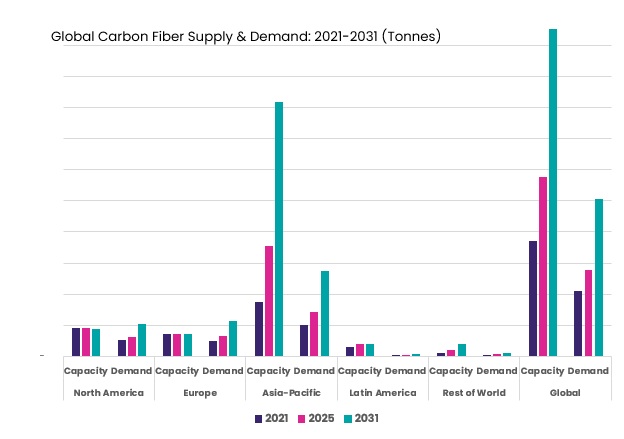
Wind energy provides another major growth platform. Increasing turbine size and longer blades raise structural and weight requirements, encouraging carbon fiber use in selected blade components. Automotive lightweighting, construction and civil engineering, molding compounds, oil and gas, sports equipment, and other industrial applications further diversify the global demand base.
The supply side is also undergoing major change. Rapid capacity expansion, particularly in China, is increasing global availability of large-tow carbon fiber, supporting penetration into cost-sensitive applications but also increasing competition and pricing pressure. Established producers are responding through higher-performance grades, capacity optimization, partnerships, application development, and greater focus on aerospace and other technically demanding markets.