

Global Carbon Fiber Market

The global carbon fiber market is projected to expand from approximately $4.4 billion in 2025 to about $5.1 billion in 2026, with demand continuing to increase strongly at 9.3% in market value and 10.5% in consumption volume through 2031 to reach $7.7 billion and 253 thousand tonnes. Asia-Pacific remains the largest regional market, supported by its extensive carbon fiber and composites manufacturing base and demand from wind energy, pressure vessels, automotive, sports and leisure, and molding compounds.
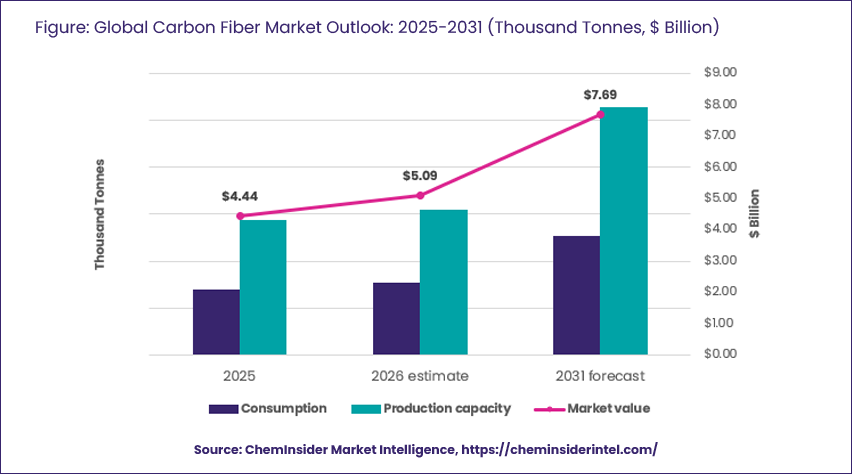
carbon fiber market outlook 2025-2031

At the application level, wind turbines represent one of the largest volume-consuming segments, while aircraft, space & defense has a significantly higher value contribution due to the use of premium high-performance fibers. Pressure vessels are among the fastest-growing applications during 2025–2031, supported by expanding hydrogen and high-pressure gas storage infrastructure, while aerospace and defense, wind turbines, and automotive applications also contribute strongly to incremental demand.

"The global carbon fiber market is entering a period of accelerated demand growth, while rapid capacity expansion and widening regional supply imbalances intensify competition, pricing pressure and the importance of product positioning."

Report Coverage

The market report is designed to provide an integrated view of the carbon fiber industry's market size, demand structure, production capacity, competitive landscape, technology evolution, and growth outlook, while mapping the key trends and drivers shaping the market through 2031.
The report covers the following major areas:

  • Global Market Size and Outlook: Analysis of global carbon fiber consumption and market value, including historical trends (2021-2025) and forecasts through 2031.
  • Regional Market Analysis: Assessment of carbon fiber market trends and outlook across major geographic markets, including North America, Europe, Asia-Pacific, Latin America, and Rest of World, with analysis of regional consumption patterns, growth rates, and market development.
  • Application Analysis: Evaluation of carbon fiber demand and market value across major applications, including aerospace & defense, sports & leisure, wind turbines, pressure vessels, automotive, construction/civil engineering, molding compounds, and other applications, as applicable to the regional and global markets.
  • Modulus Type Analysis: Market assessment by carbon fiber modulus category, examining the development and outlook of different fiber types and their role across end-use markets.
  • Production Capacity and Supply-Demand Analysis: Review of global and regional carbon fiber production capacity, demand, and capacity-demand relationships, highlighting changes in the industry's supply structure and regional capacity positioning.
  • PAN-Based and Pitch-Based Carbon Fiber Capacity: Analysis of existing and planned production capacity, including major producers, manufacturing locations, capacity additions, expansions, and changes in the global production base.
  • Competitive Landscape: Assessment of major carbon fiber producers, including their production capacities, market positions, and company shares based on 2025 capacity, providing insight into the concentration and evolving competitive structure of the industry.
  • Market Trends and Growth Drivers: Analysis of the major trends and demand drivers influencing the carbon fiber industry at the global, regional, application, and segment levels, linking market developments with observed and forecast consumption and value trends.
  • Technology and Product Developments: Coverage of important developments in high-performance carbon fibers, including advances in higher-strength and higher-performance grades and the emergence of new production capabilities, particularly developments affecting the competitive and technological landscape.
  • Industry Developments and Strategic Initiatives: Review of relevant capacity expansions, partnerships, distribution agreements, product launches, manufacturing developments, and other strategic initiatives influencing the carbon fiber supply chain and market structure.

Report Synopsis

Report Parameter Coverage
Historical Analysis 2021-2025
Base Year (Market size) 2025 ($4.4 billion)
Estimate Year (Market size) 2026 ($5.1 billion)
Forecast Period 2026-2031 (Market size 2031: $7.7 billion)
Market Measurement Consumption Volume and Market Value
Market Value US$ Million
Consumption Volume Tonnes
Market Analysis by Modulus Type Standard Modulus Large-tow, Standard Modulus Regular-tow, Intermediate Modulus, and High Modulus
Market Analysis by Application Aerospace & Defense, Sports & Leisure, Wind Turbines, Pressure Vessels, Automotive, Construction/Civil Engineering, Molding Compounds, and Other Applications
Regions Covered North America, Europe, Asia-Pacific, Latin America, and Rest of World
Countries Covered United States, Canada, Denmark, France, Germany, Italy, Spain, United Kingdom, China, India, Japan, South Korea, Taiwan, Brazil, Mexico, Russia, Turkey
Regional Analysis Consumption, market value, growth trends, application mix, and market outlook across major regions
Supply-Demand Analysis Global and regional production capacity, demand, capacity-demand ratio, and supply-demand trends
Production Capacity Analysis Historical, current, and announced/expected carbon fiber production capacity
Capacity by Fiber Type PAN-based and Pitch-based Carbon Fiber
Competitive Analysis Major carbon fiber manufacturers, production capacity, competitive positioning, and company shares based on 2025 capacity
Core Report Objective To provide an integrated assessment of carbon fiber consumption, market value, production capacity, supply-demand dynamics, competitive structure, technology developments, and the trends and drivers shaping the global market.

Frequently Asked Questions

  • 1. What is the outlook for the global carbon fiber market through 2031?

    The global carbon fiber market is expected to record 10.5% CAGR in consumption volume and 9.3% CAGR in market value during 2025-2031 to reach $7.7 billion and 253 thousand tonnes by 2031, supported by wind energy, pressure vessels, aerospace and defense.

  • 2. What are the major applications driving carbon fiber demand?

    Major applications for carbon fiber globally include aircraft, space & defense; wind turbines; and pressure vessels. Wind turbines provide substantial volume demand, aerospace and defense are particularly important in value terms, and pressure vessels are emerging as one of the strongest growth opportunities because of expanding hydrogen and high-pressure gas storage applications.

  • 3. Which region has the largest carbon fiber market?

    Asia-Pacific is the largest regional carbon fiber market and is also a major center of global production capacity. China plays an increasingly important role because of rapid capacity expansion and growing domestic consumption.

  • 4. Why is carbon fiber demand increasing in hydrogen pressure vessels?

    Carbon fiber provides the high strength-to-weight performance required for lightweight high-pressure composite cylinders. Type III and particularly Type IV pressure vessels use carbon fiber composite overwraps to withstand high storage pressures while controlling system weight.

  • 5. What is the difference between large-tow and regular-tow carbon fiber, and which is growing faster?

    Tow size refers to the number of individual filaments bundled together. Regular-tow carbon fiber (<=24k) generally serves applications requiring higher performance, processing consistency and established qualification, while large-tow carbon fiber, including grades such as 30K, 48K, 50K and 60K, is increasingly targeted toward high-volume applications where productivity and material cost are critical.

  • 6. What are the major restraints facing the carbon fiber market?

    The principal restraints are high fiber and composite manufacturing costs, capital- and energy-intensive production, complex processing, lengthy qualification requirements, competition from lower-cost structural materials, and supply-demand imbalance. Rapid global capacity expansion can reduce prices and encourage adoption, but it can also lower utilization rates and profitability for producers.

Report Scope

The report provides historical estimates (2021-2025) and forecasts (2025-2031) of carbon fiber consumption (Tonnes) and market value (US$) for the period 2021-2031. Market projections are developed by considering historical growth patterns, application-level demand, regional market conditions, production capacity developments, technology trends, competitive dynamics, and other factors that may influence the carbon fiber industry during the forecast period.

Regional Segmentation

The report segments carbon fiber market analysis by following geographic regions:

North America

  • United States
  • Canada

Europe

  • Denmark
  • France
  • Germany
  • Italy
  • Spain
  • United Kingdom
  • Rest of Europe

Asia-Pacific

  • China
  • India
  • Japan
  • South Korea
  • Taiwan
  • Rest of Asia-Pacific

Latin America

  • Brazil
  • Mexico
  • Rest of Latin America

Rest of World

  • Russia
  • Turkey
  • Other Rest of World (include other Middle-East and Africa)

Application Segmentation

Carbon fiber market by application covered in this report include:

  • Aircraft, Space & Defense
  • Sports & Leisure
  • Wind Turbines
  • Automotive (including other transportation such as train, marine)
  • Pressure Vessels
  • Construction / Civil Engineering
  • Molding Compounds
  • Other applications (include oil & gas, medical, and other miscellaneous)

Modulus-Type Segmentation

Carbon fiber market by modulus type covered in this report include:

  • Standard Modulus, Large-tow
  • Standard Modulus, Regular-tow
  • Intermediate Modulus
  • High Modulus

Table of Contents (Download Full TOC & Report Scope )

Executive Summary

  • Summary & Highlights
    • Carbon Fiber Market Trends, Drivers & Restraints
      • Major Carbon Fiber Market Trends
      • Key Market Drivers
      • Key Market Restraints
      • Competitive Landscape: A Major Market Transformation
      • Strategic Response of Carbon Fiber Producers
    • Regional Trends and Outlook
    • Application Trends and Outlook
    • Modulus-Type Trends and Outlook
    • Executive Outlook
  • Scope & Methodology
    • Report Scope
    • Information Sources
    • Copyright & Licensing

Introduction to Carbon Fiber

  • Structure and Material Characteristics
  • Classification by Precursor
    • PAN-Based Carbon Fiber
    • Pitch-Based Carbon Fiber
  • Classification by Mechanical Performance
  • Commercial Product Forms
  • Carbon Fiber Composite Systems
  • Application Areas

Recent Industry Developments

  • Recent Carbon Fiber Capacity Expansions and New Market Entrants
  • Carbon Fiber Industry Witnesses Transformative Innovation Through Sustainable Feedstocks, Advanced Manufacturing, and AI Integration
  • Aerospace Carbon Fiber Composites: Key Technology, Certification, and Supply Chain Developments Shaping the Next Generation of Aviation
  • Carbon Fiber Industry Accelerates Innovation Through New Materials, Advanced Applications, and Strategic Collaborations
  • Global Breakthroughs in High-Strength Carbon Fiber Technology
  • Strategic Partnerships and Acquisitions
  • Carbon Fiber Recycling Trends 2026

Industry Landscape

  • Carbon Fiber Production Capacity
    • Global Capacity Trend: 2015-2025
    • Global Capacity Outlook: 2025-2030
    • PAN-based Carbon Fiber Capacity
    • Pitch-based Carbon Fiber Capacity
  • Industry Players
    • Carbon Fiber Producers
          • Aksa Carbon
          • Changsheng (Langfang) Technology Co., Ltd.
          • Composite Division (State Atomic Energy Corporation Rosatom)
          • Formosa Plastics Corporation
          • Gansu HaoShi Carbon Fiber Co., Ltd.
          • Hexcel Corporation
          • HS Hyosung Advanced Materials
          • Jiangsu Hengshen Co., Ltd.
          • Jilin Chemical Fiber Group Co., Ltd.
          • Kureha Corporation
          • Mitsubishi Chemical Corporation
          • Newtech Group Co., Ltd.
          • Nippon Graphite Fiber Corporation
          • Osaka Gas Chemicals Co Ltd.
          • SGL Carbon SE
          • Shandong Guotai Dacheng Technology Co., Ltd.
          • Shandong Yongcheng New Materials Co., Ltd.
          • Sinopec Shanghai Petrochemical Co., Ltd.
          • Syensqo SA
          • Teijin Limited
          • Toray Industries, Inc.
            • ZOLTEK Corporation
          • Weihai Guangwei Composites Co., Ltd.
          • Zhongfu Shenying Carbon Fiber Co., Ltd.
    • New Entrants & Raw Material Suppliers
      • ACP Technologies, LLC
      • Jindal Advanced Materials
      • LeMond Carbon Inc.
      • Reliance Industries Ltd.
    • Technology Providers
      • 4M Carbon Fiber Corp.
      • Harper International Corp.
      • Zhejiang Jinggong Integration Technology Co., Ltd.
      • UHT Unitech Co., Ltd.
    • Defunct or Dormant Carbon Fiber Producers
      • Anshan Sinocarb Carbon Fibers Co., Ltd.
      • Shanxi Gangke Carbon Material Co., Ltd.
      • Taekwang Industrial Co., Ltd.
      • Montefibre Carbon
      • Xinjiang Runjust New Material Co. Ltd

Global: Carbon Fiber Market Trends & Outlook

  • Trends & Outlook by Region
  • Trends & Outlook by Application
  • Trends & Outlook by Modulus Type
  • Supply & Demand Analysis

North America: Carbon Fiber Market Trends & Outlook

  • Trends & Outlook by Country
  • Trends & Outlook by Application
  • Trends & Outlook by Modulus Type
  • Supply & Demand Analysis
  • United States
    • Trends & Outlook by Application
  • Canada
    • Trends & Outlook by Application

Europe: Carbon Fiber Market Trends & Outlook

  • Trends & Outlook by Country
  • Trends & Outlook by Application
  • Trends & Outlook by Modulus Type
  • Supply & Demand Analysis
  • Denmark
    • Trends & Outlook by Application
  • France
    • Trends & Outlook by Application
  • Germany
    • Trends & Outlook by Application
  • Italy
    • Trends & Outlook by Application
  • Spain
    • Trends & Outlook by Application
  • United Kingdom
    • Trends & Outlook by Application
  • Rest of Europe
    • Trends & Outlook by Application

Asia-Pacific: Carbon Fiber Market Trends & Outlook

  • Trends & Outlook by Country
  • Trends & Outlook by Application
  • Trends & Outlook by Modulus Type
  • Supply & Demand Analysis
  • China
    • Trends & Outlook by Application
  • India
    • Trends & Outlook by Application
  • Japan
    • Trends & Outlook by Application
  • South Korea
    • Trends & Outlook by Application
  • Taiwan
    • Trends & Outlook by Application
  • Rest of Asia-Pacific
    • Trends & Outlook by Application

Latin America: Carbon Fiber Market Trends & Outlook

  • Trends & Outlook by Country
  • Trends & Outlook by Application
  • Trends & Outlook by Modulus Type
  • Supply & Demand Analysis
  • Brazil
    • Trends & Outlook by Application
  • Mexico
    • Trends & Outlook by Application
  • Rest of Latin America
    • Trends & Outlook by Application

Rest of World: Carbon Fiber Market Trends & Outlook

  • Trends & Outlook by Country
  • Trends & Outlook by Application
  • Trends & Outlook by Modulus Type
  • Supply & Demand Analysis
  • Russia
    • Trends & Outlook by Application
  • Turkey
    • Trends & Outlook by Application
  • Other Rest of World
    • Trends & Outlook by Application

Related Reports

Global Fumed (Pyrogenic) Silica Market Size, Share & Forecast (2026 Edition)

Global fumed silica market to reach US$2.61 billion by 2031. Explore market size, demand, production capacity, leading manufacturers and regional forecasts.

  • Published: November 2026
  • Pages: 128
  • Tables & Figures: 153
View Report

Global Precipitated Silica Market Size, Share, Capacity & Forecast (2026 Edition)

Global precipitated silica market to reach US$6.27 billion by 2031. Explore market size, growth, capacity, leading producers, applications and regional outlook.

  • Published: October 2026
  • Pages: 166
  • Tables & Figures: 195
View Report