


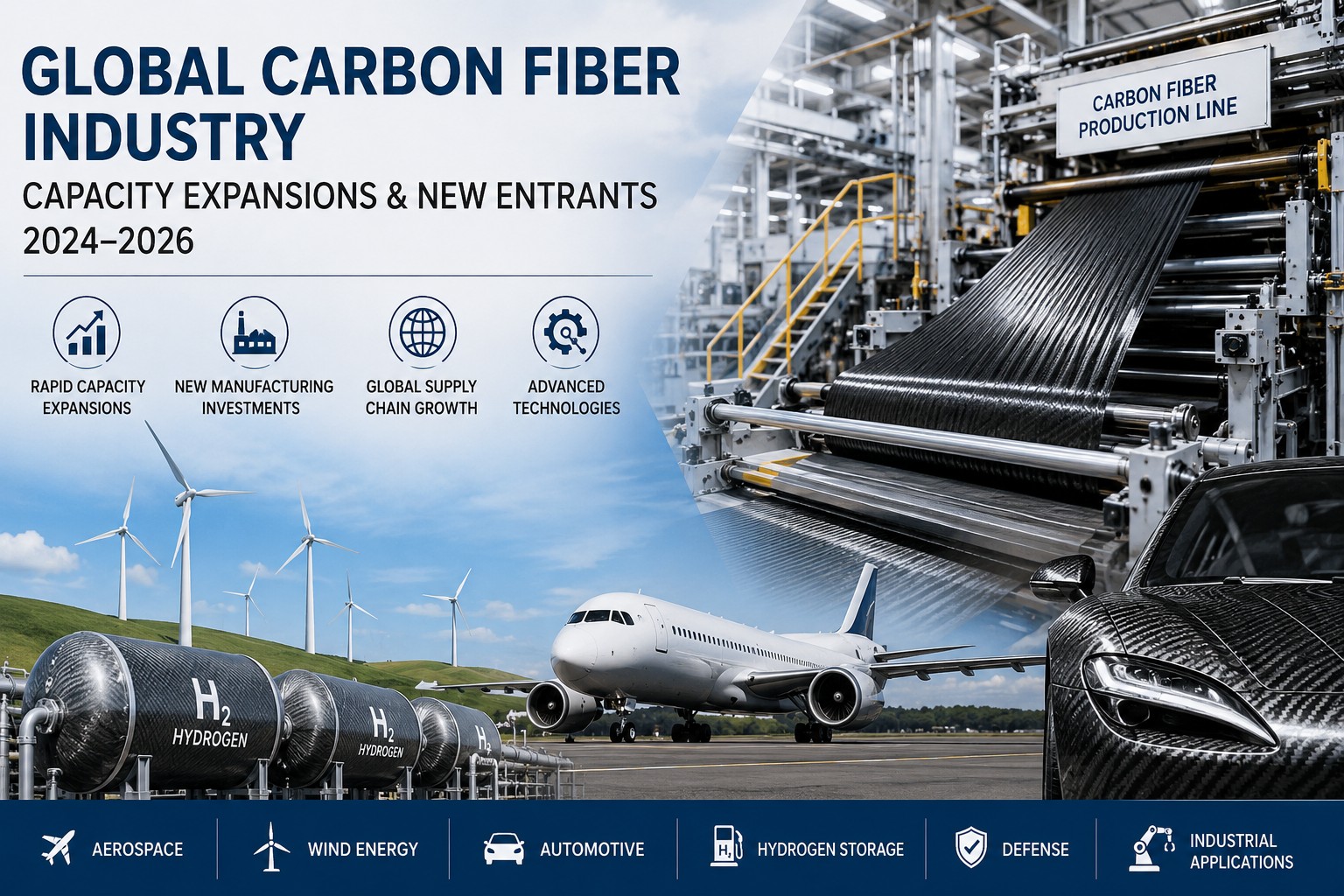
Global carbon fiber manufacturers are accelerating capacity expansions and launching new production facilities as demand from aerospace, renewable energy, automotive, hydrogen, and defense sectors continues to strengthen worldwide. Recent developments between 2024 and 2026 highlight a significant wave of investments aimed at increasing production capacity, strengthening regional supply chains, and advancing next-generation manufacturing technologies.
China remains at the forefront of this expansion cycle, with companies including Zhongfu Shenying Carbon Fiber Co. and Sinopec commissioning large-scale carbon fiber production lines to support domestic demand for high-performance materials. These projects include high-strength, high-modulus, and large-tow carbon fiber designed for aerospace, wind energy, electric vehicles, and advanced industrial applications.
Europe is also expanding its manufacturing footprint through investments by Toray Carbon Fibers Europe, while the National Composites Centre (NCC) and CPI are developing the U.K.'s Carbon Fibre Development Facility to strengthen domestic research, innovation, and future production capabilities. In parallel, Mitsubishi Chemical announced plans to nearly double high-performance carbon fiber production capacity across its facilities in Japan and the United States, supporting growing demand from aerospace, sports equipment, and premium automotive markets.
Emerging markets are becoming increasingly active in carbon fiber manufacturing. Gulf Carbon Fiber Industries Holding (GCFI) unveiled a USD 120 million advanced composites platform in Qatar, while LeMond Carbon UK announced plans to establish a new carbon fiber manufacturing facility focused on wind turbine blades and hydrogen storage applications. India also advanced its domestic production ambitions through Jindal Advanced Materials' partnership with Italy's MAE S.p.A. to develop an integrated carbon fiber manufacturing plant. In 2022, Reliance Industries announced plans to establish India's first and one of the world's largest carbon fiber manufacturing facilities at Hazira, Gujarat, with a planned capacity of 20,000 tonnes per year based on acrylonitrile feedstock as part of its Oil-to-Chemicals investment program, and in 2026 the company reaffirmed carbon fiber as a strategic pillar of its transformation into a leading producer of advanced materials.
Alongside new production capacity, manufacturers are investing heavily in process innovation. Companies such as 4M Carbon Fiber are commercializing advanced plasma oxidation technology to improve manufacturing efficiency and reduce production costs, while equipment suppliers including Harper International continue supporting commercial-scale carbon fiber projects worldwide through advanced carbonization technologies.
The recent investment cycle also reflects the industry's strategic focus on supply chain resilience. Governments and manufacturers across Europe, North America, Asia, and the Middle East are prioritizing domestic carbon fiber production to reduce dependence on imports and support critical industries including aerospace, defense, clean energy, hydrogen infrastructure, and advanced mobility.
Although the industry continues to face challenges from global overcapacity and pricing pressure in certain segments, ongoing restructuring efforts are enabling manufacturers to concentrate investments on higher-value applications and more efficient production technologies. As additional projects become operational over the coming years, global carbon fiber production capacity is expected to expand significantly, supporting long-term demand across multiple high-growth industries.
The capacity expansion initiatives announced between 2024 and 2026 demonstrate that the carbon fiber industry is entering a new phase of global growth driven by technological innovation, regional manufacturing investment, and increasing demand for lightweight, high-performance materials. These developments are expected to strengthen global supply chains, improve production capabilities, and reinforce carbon fiber's role as a critical material for the next generation of transportation, energy, industrial, and defense applications.