


The global carbon fiber market is entering a new phase of innovation as manufacturers, research institutions, and technology companies accelerate the development of sustainable raw materials, intelligent manufacturing systems, and cost-effective production technologies. Recent industry developments highlight a growing industry-wide focus on reducing carbon emissions, diversifying precursor materials, and expanding domestic carbon fiber production to meet increasing demand from aerospace, automotive, renewable energy, defense, and industrial applications.
A major breakthrough came in 2026 when Canadian startup Fibernx successfully produced carbonized carbon fiber from asphaltene-based feedstock using a continuous carbonization process for the first time. The technology is expected to significantly lower production costs while reducing greenhouse gas emissions compared to conventional PAN-based carbon fiber manufacturing. Supporting this transition, Harper International commissioned a scientific production line at Alberta Innovates to accelerate research and scale-up of bitumen-derived carbon fiber technologies.
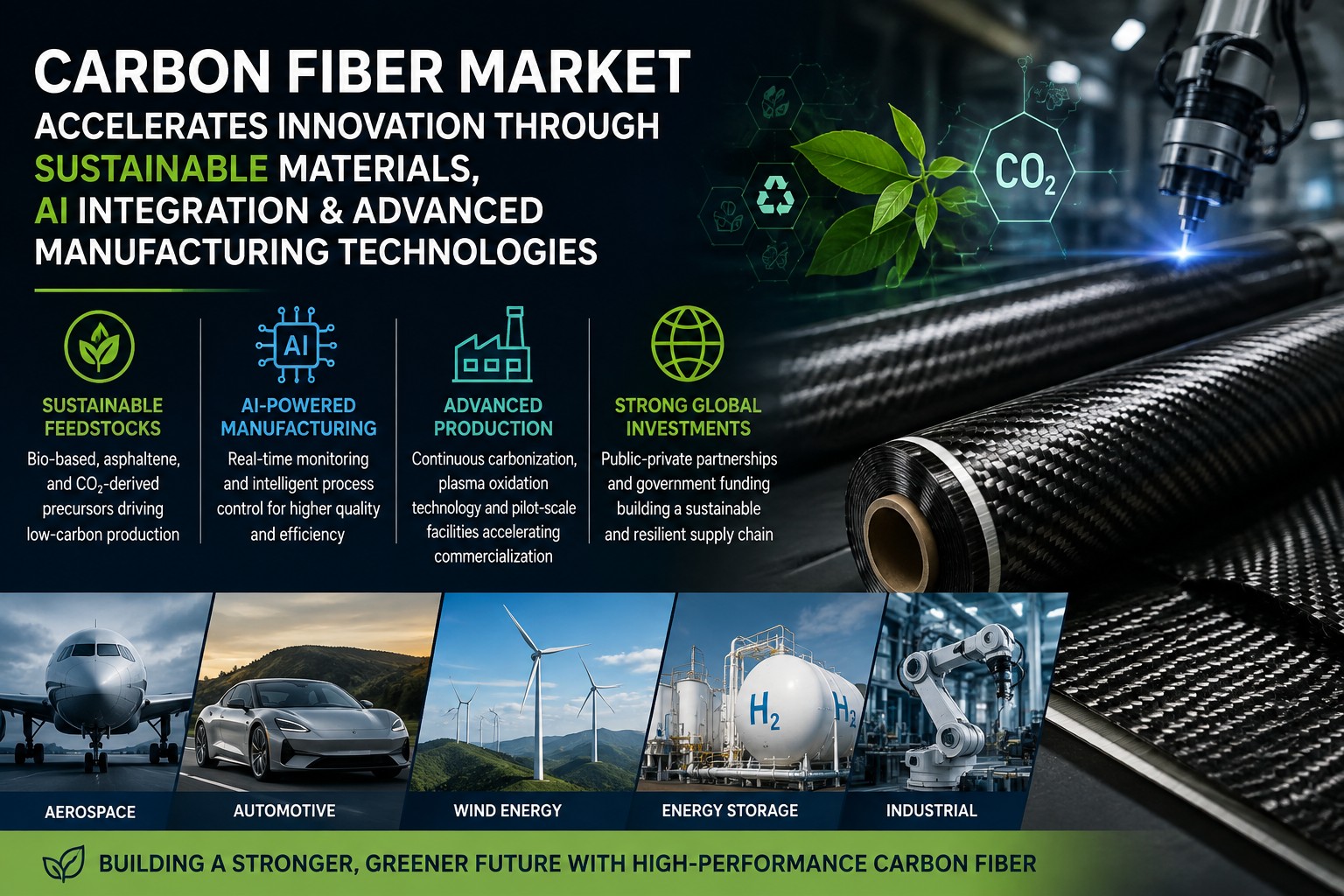
Sustainability remains a central growth driver across the carbon fiber market. Teijin expanded its Tenax™ Carbon Fiber portfolio using ISCC PLUS-certified sustainable acrylonitrile derived from biomass and recycled feedstocks, while Trillium Renewable Chemicals secured funding to commercialize the world's first demonstration plant for 100% bio-based acrylonitrile, a critical precursor for carbon fiber production. Similarly, Mars Materials validated a carbon-negative, CO₂-derived PAN precursor, demonstrating a promising pathway toward lower-emission carbon fiber manufacturing.
Governments and research organizations continue investing heavily in next-generation carbon fiber technologies. Oak Ridge National Laboratory and ACP Technologies have advanced pitch-based carbon fiber production through pilot-scale manufacturing, while Germany's Fraunhofer Institute is establishing a €53 million pilot facility to produce bio-based carbon fiber from renewable cellulose and lignin feedstocks. These initiatives are strengthening regional supply chains while supporting commercialization of sustainable carbon fiber technologies.
Collectively, these advancements signal a significant transformation in the global carbon fiber market. The convergence of alternative precursor materials, AI-powered manufacturing, bio-based feedstocks, and large-scale public and private investments is making carbon fiber production more sustainable, efficient, and economically viable. As commercialization efforts continue, the industry is expected to expand the adoption of carbon fiber across lightweight transportation, clean energy, aerospace, and advanced industrial applications, reinforcing its role as a critical material for the next generation of high-performance engineering solutions.