


The aerospace carbon fiber composites market is witnessing rapid technological advancement as leading manufacturers accelerate innovation in lightweight materials, automated production, and aerospace certification. Recent industry developments highlight growing investments in next-generation carbon fiber composites designed to support commercial aviation, defense, advanced air mobility (AAM), unmanned aerial vehicles (UAVs), and space programs.
Major companies including Toray, Hexcel, Teijin Carbon, Syensqo, Guangwei Composites, and Mitsubishi Chemical have introduced new composite materials, expanded National Center for Advanced Materials Performance (NCAMP) qualifications, secured long-term aerospace supply agreements, and developed advanced manufacturing technologies that reduce production time while maintaining structural performance. Fast-cure prepregs, thermoplastic composites, automated fiber placement (AFP), out-of-autoclave processing, and vacuum-assisted resin transfer molding (VARTM) are emerging as key technologies enabling high-rate aircraft production.
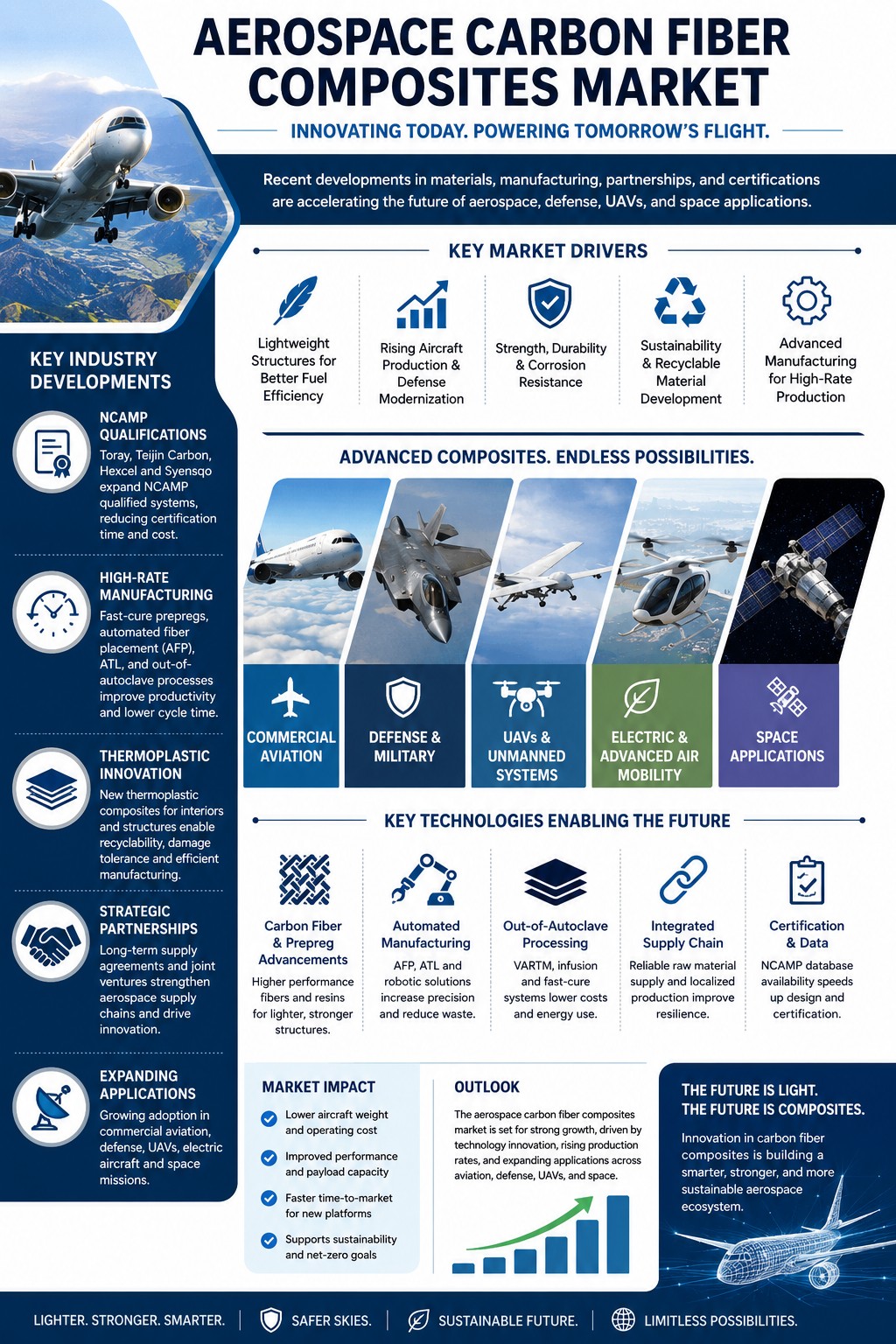
The industry is also strengthening global aerospace supply chains through strategic partnerships with aircraft manufacturers and defense contractors while expanding carbon fiber applications across electric aircraft, next-generation military platforms, satellite systems, and commercial aviation. These innovations are helping manufacturers improve production efficiency, accelerate certification timelines, reduce aircraft weight, and support the aviation sector's long-term sustainability goals.
As aircraft production ramps up worldwide, carbon fiber composites are becoming increasingly essential for improving fuel efficiency, operational performance, and manufacturing scalability. The latest advancements position advanced composite materials at the center of future aerospace innovation, supporting the industry's transition toward more efficient, resilient, and sustainable aircraft.
Outlook
Recent aerospace carbon fiber developments demonstrate that future industry competition will extend beyond material performance alone. Companies are increasingly differentiating themselves through faster certification pathways, manufacturing productivity improvements, automation compatibility, resilient supply chains, and strategic collaborations with aircraft manufacturers. NCAMP qualification continues emerging as an industry standard for accelerating commercialization, while fast-cure prepregs, thermoplastic composites, automated manufacturing technologies, and out-of-autoclave processing are reshaping aerospace production economics. Simultaneously, growing investments in commercial aviation recovery, advanced air mobility, defense modernization, unmanned aircraft, and commercial space programs are creating sustained demand for advanced carbon fiber composites. As aerospace manufacturers seek to increase production rates while reducing costs and improving sustainability, suppliers capable of delivering certified materials, scalable manufacturing solutions, and reliable long-term supply partnerships will be best positioned to capitalize on the industry's next growth phase.