


The regulatory landscape for allulose has expanded considerably, opening additional geographic markets and supporting investment in production capacity, distribution, and new food and beverage applications.
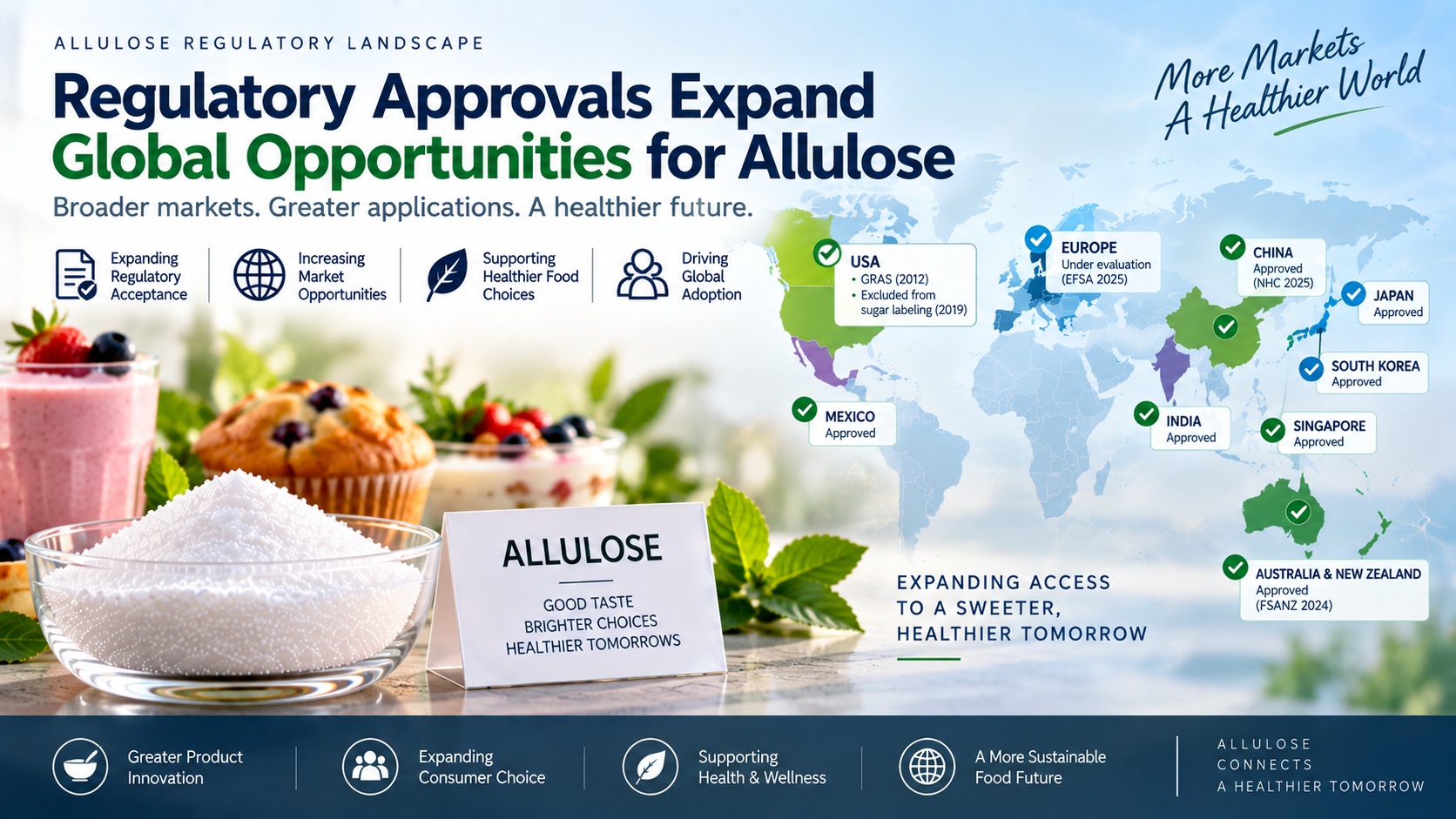
The United States provided an early foundation for commercialization. Allulose achieved GRAS status in 2012, while an important regulatory change followed in 2019 when the U.S. FDA allowed allulose to be excluded from “total sugars” and “added sugars” declarations on Nutrition Facts labels and used a lower caloric value for nutrition labeling.
Since then, regulatory acceptance has expanded across several international markets, including Japan, South Korea, Singapore, Mexico, India, and other countries.
A major development occurred in November 2024 when Samyang Corporation received Novel Food approval from Food Standards Australia New Zealand (FSANZ). According to Samyang, it became the first allulose producer to secure Novel Food approval in Australia and New Zealand.
China represented another major regulatory milestone in 2025. The National Health Commission approved D-allulose as a new food ingredient under Announcement No. 4 of 2025.
The Chinese approvals are also notable for recognizing different manufacturing technologies. MicroCyto received approval for allulose produced using its AS10 direct fermentation process, while COFCO Biotechnology received approval associated with an enzymatic production route.
Regulatory expansion is closely connected with manufacturing investment. China has rapidly expanded allulose capacity, while Samyang's Australia and New Zealand approval followed completion of its new 13,000-tonne/year allulose plant in South Korea.
Europe remains a notable exception to the wider trend. In 2025, the European Food Safety Authority was unable to establish the safety of D-allulose based on the information available in the evaluated application, leaving European commercialization more constrained than in several other major markets.
The widening regulatory footprint is nevertheless increasing the addressable global market for allulose. As additional countries permit its use, producers gain access to larger food manufacturing bases and greater opportunities to commercialize both liquid and crystalline products.
Regulatory development will therefore remain a critical factor determining how quickly the industry's rapidly expanding production capacity translates into actual consumption growth.