


The global allulose industry is undergoing a major capacity expansion as ingredient manufacturers increase production to support the emerging market for low-calorie and reduced-sugar food products. New plants and expansion projects across China, South Korea, Thailand, and other markets are transforming allulose from a relatively limited specialty sweetener into an increasingly industrial-scale ingredient.
Global allulose production capacity increased from approximately 15 thousand tonnes in 2021 to around 128 thousand tonnes in 2025. Based on identified projects and expansion plans, capacity could reach approximately 310 thousand tonnes by 2031.
China has emerged as the largest center of new capacity. Baolingbao Biology commissioned a 20,000-tonne/year intelligent allulose plant in May 2026, increasing its total capacity to 30,000 tonnes/year. Shandong Sanyuan Biotechnology also brought its entire 20,000-tonne/year allulose project into operation in June 2026.
MicroCyto and Sinopharm International have established a joint venture targeting large-scale fermentation-based allulose manufacturing, while Huakang Pharmaceutical is incorporating allulose into its major corn deep-processing platform. Bailong Chuangyuan is also expanding internationally through a new manufacturing facility in Thailand that is planned to add 19,000 tonnes/year of allulose capacity.
South Korea remains another important production center. Samyang Corporation completed a 13,000-tonne/year allulose facility in Ulsan in 2024, while Daesang previously established commercial production in Gunsan.
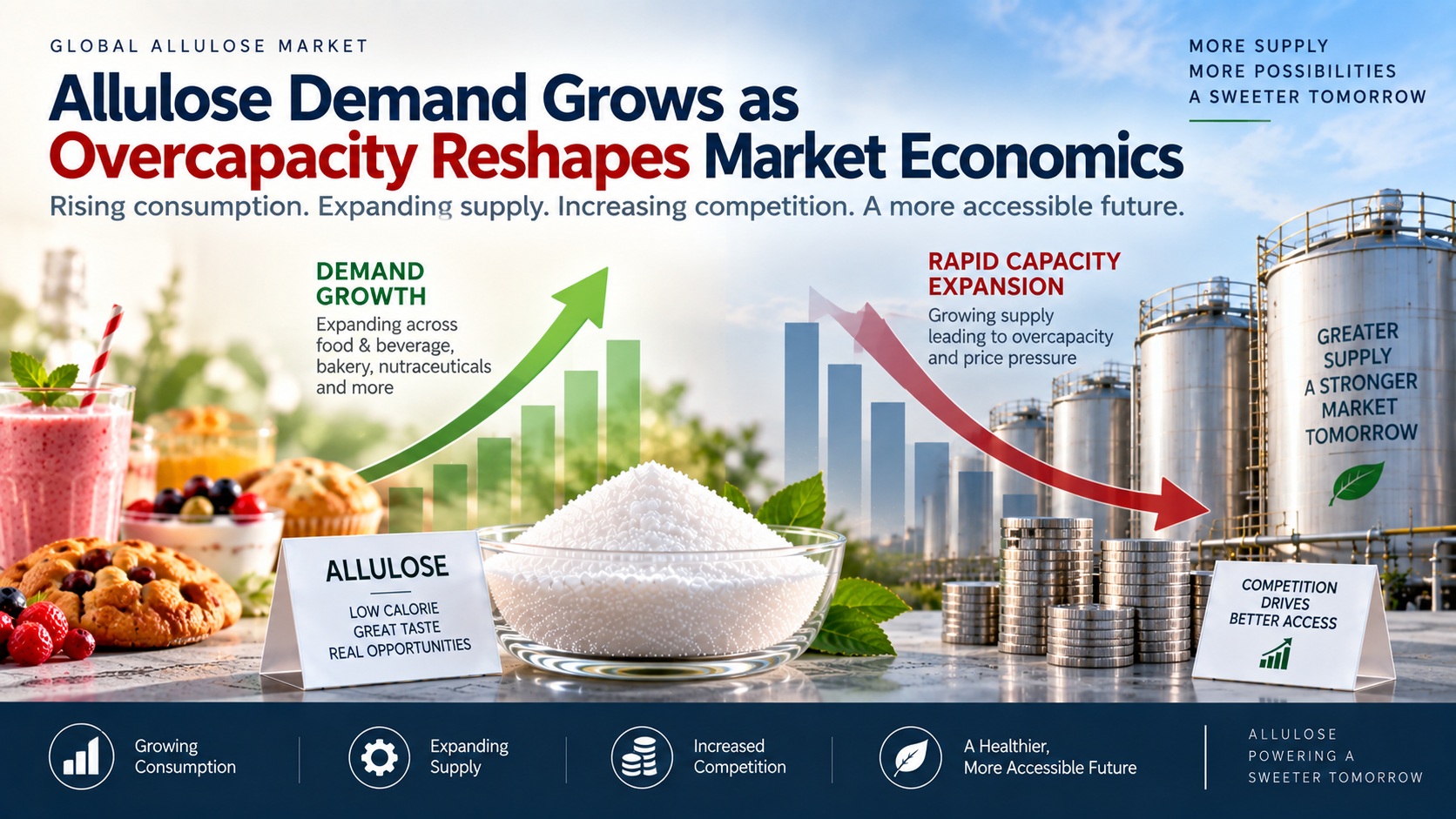
However, manufacturing capacity has expanded considerably faster than demand. Global allulose consumption reached approximately 20 thousand tonnes in 2025, compared with production capacity of 128 thousand tonnes. This resulted in a demand-to-capacity ratio of only around 15.4%.
The resulting overcapacity has intensified competition and contributed to declining allulose prices. Nevertheless, regulatory approvals in additional markets, expanding sugar-reduction applications, increasing product launches, and technological improvements could progressively absorb part of the available capacity.
The next phase of competition is therefore likely to focus increasingly on production costs, capacity utilization, crystalline versus liquid product availability, regulatory access, distribution networks, and application-development capabilities rather than capacity expansion alone.