


Technological innovation is becoming an important competitive factor in the global allulose industry as manufacturers seek more efficient production routes and lower manufacturing costs. Among the most significant recent developments is the emergence of direct fermentation as an alternative to established enzymatic conversion processes.
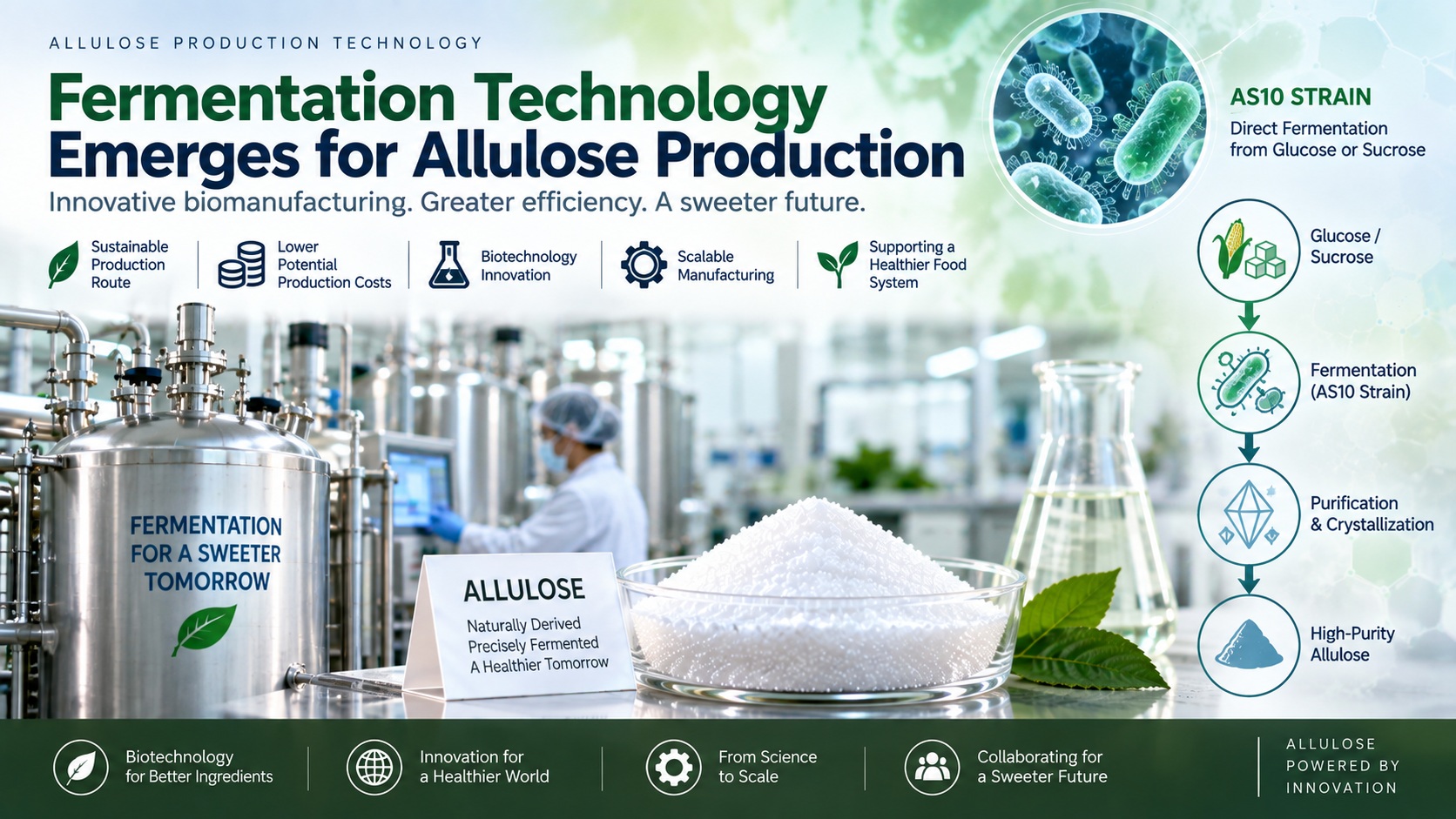
Allulose has traditionally been produced through enzymatic conversion of fructose. MicroCyto has developed an alternative biomanufacturing pathway using its AS10 strain, enabling direct fermentation-based production from glucose or sucrose.
The process was developed through MicroCyto's synthetic biology platform using gene identification, modular gene assembly, enzyme modification and strain engineering. According to the company, the process can produce allulose through fermentation and crystallization without requiring complex chromatographic separation.
Commercial development began before regulatory approval. In November 2023, MicroCyto and Sinopharm International established Sinopharm Weiyuan (MicroCyto) Technology (Qinhuangdao) Co., Ltd., with allulose selected as the joint venture's first project. Pilot-scale testing had already been completed, and the venture outlined plans for 30,000 tonnes/year of biomanufacturing capacity, with potential subsequent expansion.
A major milestone followed in July 2025 when MicroCyto's fermentation-produced allulose received regulatory approval from China's National Health Commission. The approved AS10 process represented a distinct production pathway from the enzymatic route approved for COFCO Biotechnology.
Commercialization followed quickly. In August 2025, MicroCyto entered into a distribution agreement with Cargill to expand its allulose products across the Chinese food industry.
The emergence of fermentation adds a new technological dimension to the allulose market. If successfully scaled, direct fermentation could potentially influence feedstock flexibility, process complexity and production economics.
Manufacturing technology is likely to become increasingly important as global allulose capacity expands and competition intensifies. Future competitiveness will depend not simply on installed capacity but on conversion efficiency, yields, purification requirements, energy consumption and overall production costs.
The development of fermentation-based allulose therefore represents an important trend to watch as producers seek technologies capable of supporting allulose's transition toward a more widely used bulk sugar-reduction ingredient.