


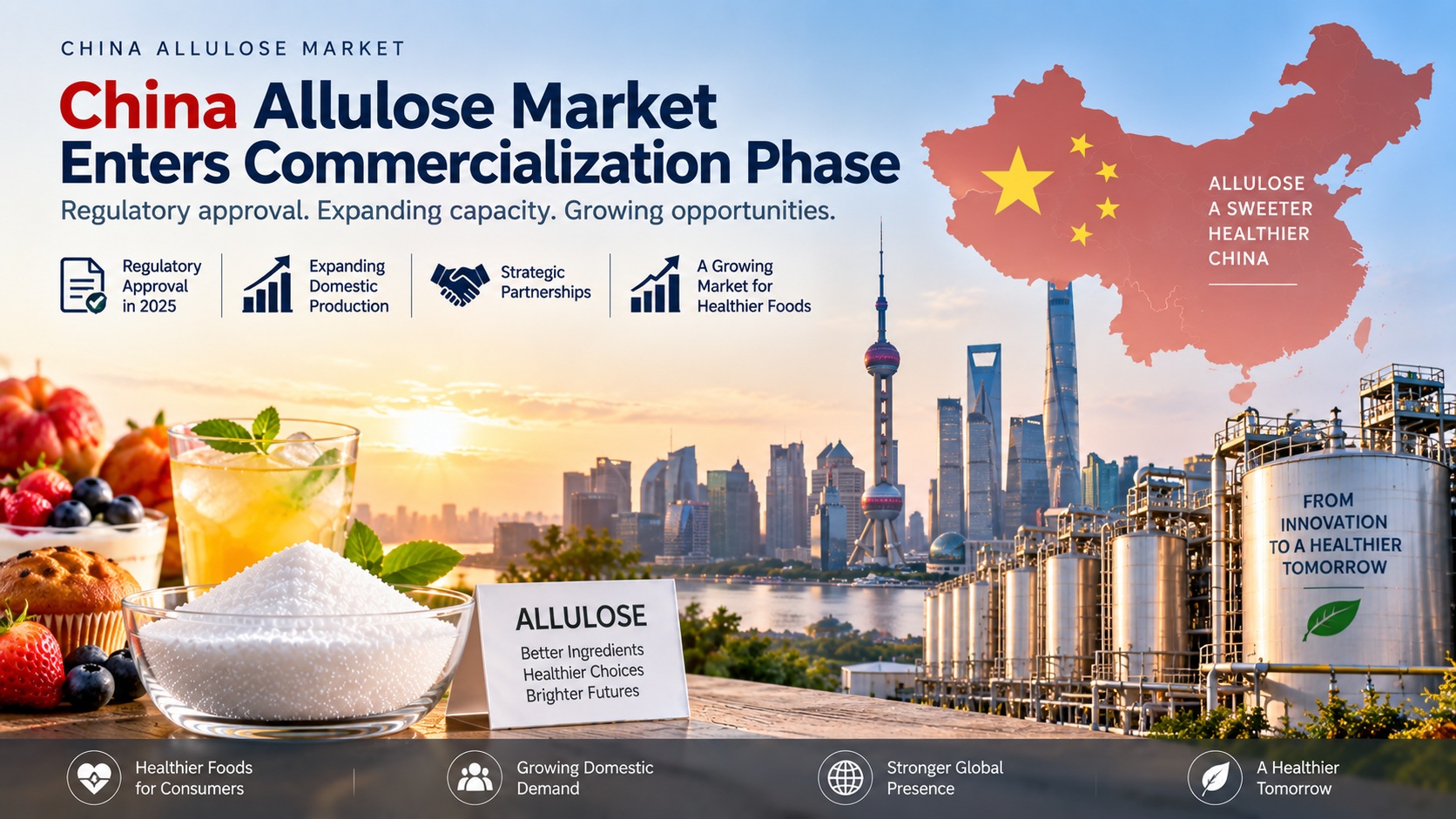
China is emerging as one of the most important growth markets for allulose following regulatory approval of D-allulose as a new food ingredient in 2025. The development has created opportunities for domestic commercialization at a time when Chinese manufacturers are rapidly expanding production capacity and developing new manufacturing technologies.
In July 2025, China's National Health Commission approved D-allulose under Announcement No. 4 of 2025. The approvals included different production pathways developed by MicroCyto and COFCO Biotechnology.
MicroCyto received approval for its AS10 direct fermentation technology, which produces allulose through a synthetic-biology-based fermentation process. The company described the development as China's first approval of a new food ingredient produced using synthetic biotechnology.
COFCO Biotechnology, working with the COFCO Nutrition and Health Research Institute, received approval for its enzymatic production process, establishing another commercial production route for D-allulose in China.
The regulatory breakthrough followed substantial investment in domestic manufacturing. Chinese producers including Baolingbao Biology, Shandong Sanyuan Biotechnology, Bailong Chuangyuan, Huakang Pharmaceutical, COFCO Biotechnology, and MicroCyto have established or announced significant allulose production capabilities.
Commercialization is also moving downstream. In August 2025, MicroCyto signed a cooperation agreement with Cargill, under which Cargill became a key distribution partner for MicroCyto's allulose products in China.
China's allulose consumption remains at an early stage compared with its manufacturing capacity. However, consumption is projected to accelerate substantially as regulatory approval enables wider incorporation into food and beverage applications. By 2031, China's allulose consumption is projected to reach approximately 55 thousand tonnes, with a market value of around US$234.7 million. The combination of regulatory approval, large domestic production capacity, enzymatic and fermentation-based manufacturing technologies, and expanding distribution channels positions China to become increasingly important to both global allulose supply and future demand.